What Is Maamoul and Where Does It Come From?
Maamoul is a small Levantine shortbread cookie, shaped in a carved mold and filled with dates, pistachios or walnuts. Its name comes from the Arabic ma'mul — "made, worked by hand" — a tribute to the artisanal gesture that has defined it for centuries.
Its roots lie in the kitchens of Syria, Lebanon, Palestine and Jordan, where every family fiercely guards its own recipe. Some food historians trace its ancestors to the filled cakes of ancient Egypt, such as kahk, depictions of which survive on the walls of pharaonic tombs. What is certain is that maamoul as we know it — semolina dough enriched with clarified butter, a pressed filling, a molded pattern — was codified in the Ottoman-era Levant.
Maamoul is above all a festive cookie. It is not baked casually: it marks major religious occasions, and its preparation as a family — often entire days with three generations taking turns around the table — is an integral part of the ritual.
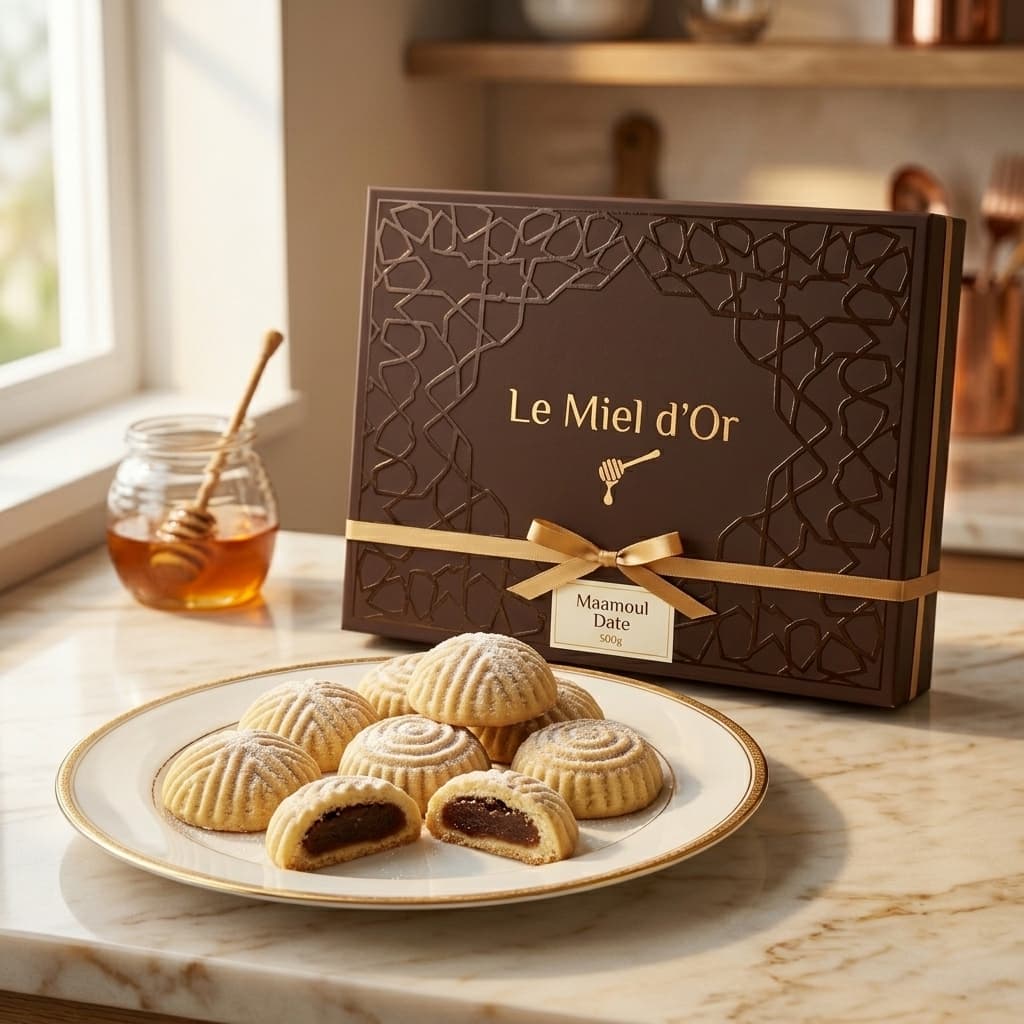
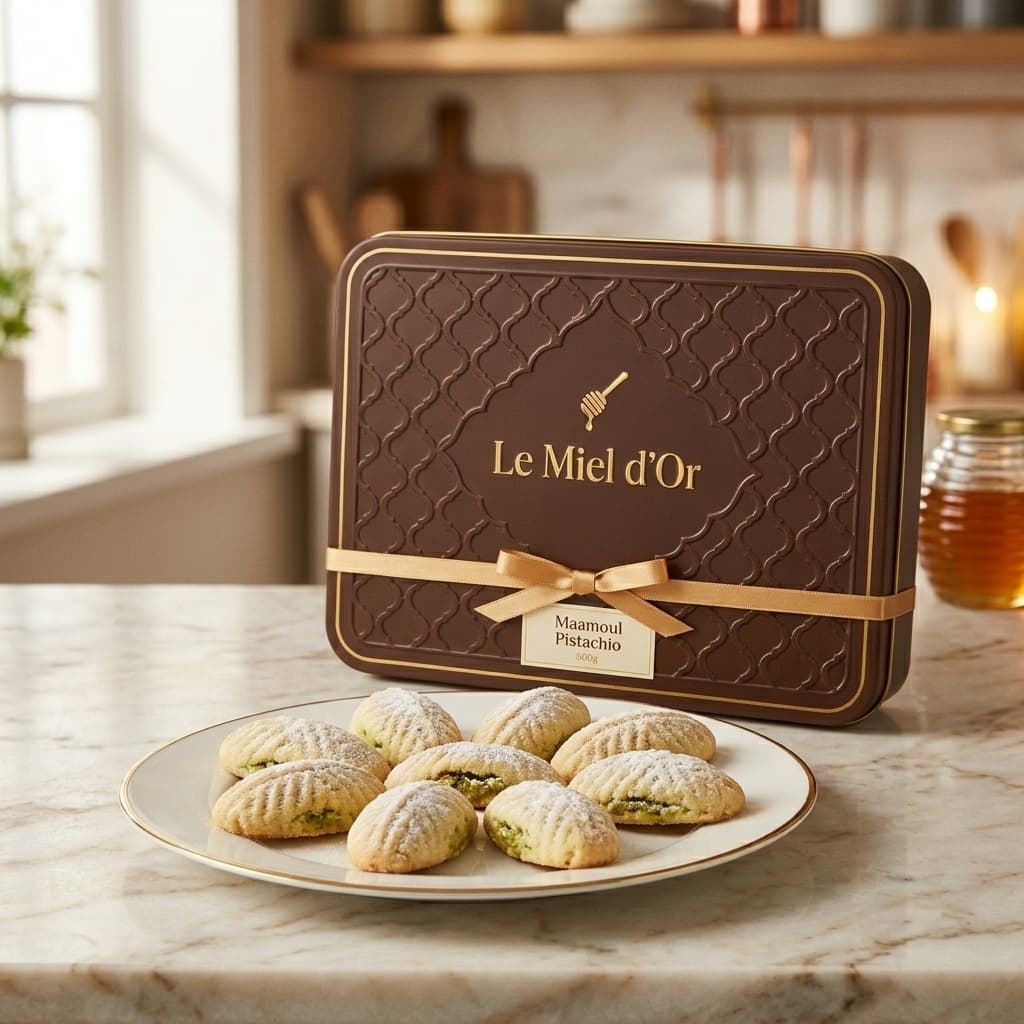
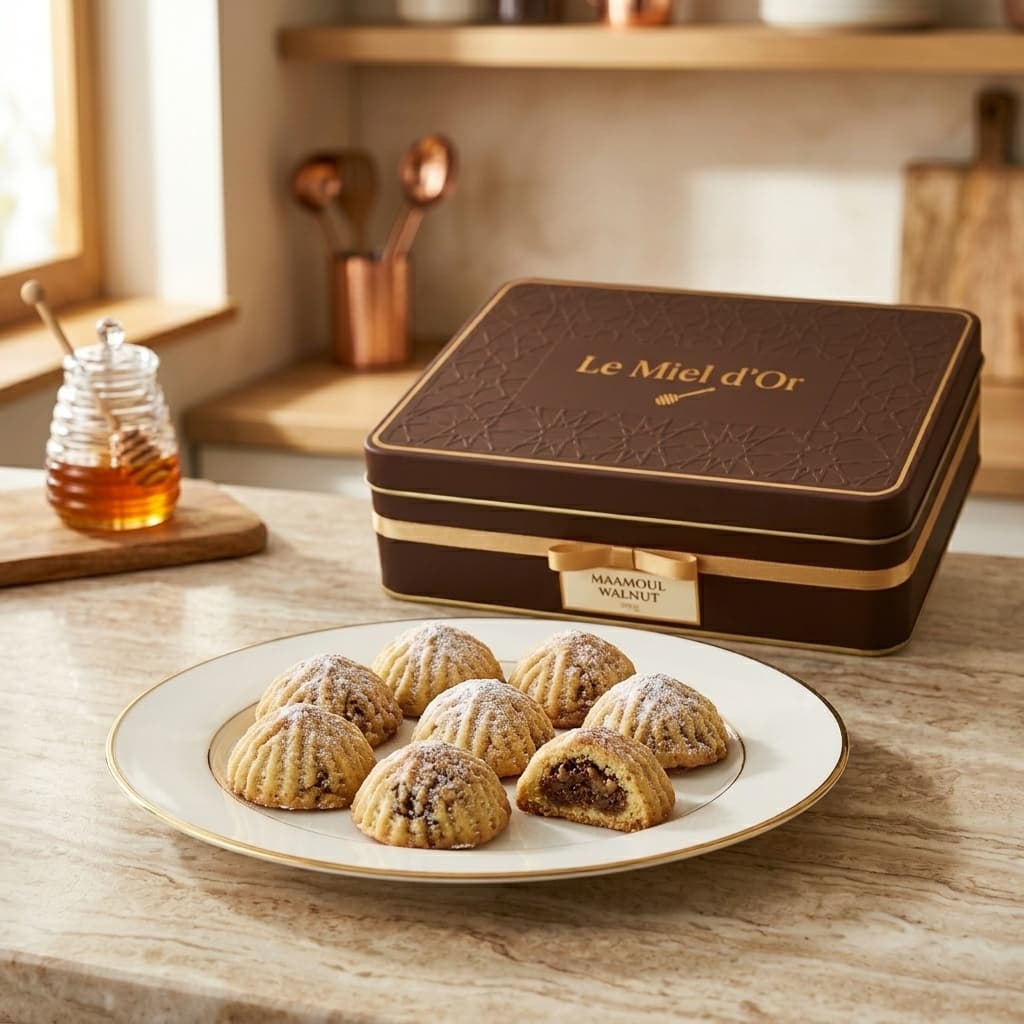
In the UAE, home to large Syrian, Lebanese, Palestinian and Jordanian communities, maamoul has become a staple of fine patisseries. Our Levantine selection includes it in its three classic fillings: date, pistachio and walnut.
Why Is Maamoul Eaten at Both Eid and Easter?
Maamoul is eaten at both Eid and Easter because, throughout the Levant, it is the cookie that celebrates the end of a fast — Ramadan for Muslims, Lent for Christians. Few pastries are so genuinely shared between two religious traditions.
In Muslim households, maamoul-making fills the final days of Ramadan: trays pile up ready to welcome visitors on Eid al-Fitr, served alongside bitter coffee. Offering your household's maamoul is a codified gesture of hospitality — hosts are (gently) judged on the delicacy of their dough.
Among Levantine Christians — Greek Orthodox, Maronite, Melkite — the very same cookie appears at Easter, at the end of Lent. Tradition adds a symbolic reading: the serrated crown of the walnut maamoul is said to evoke the crown of thorns, while the icing sugar that blankets it represents resurrection and purity.
This double belonging is no coincidence but the reflection of centuries of neighbourliness: in Damascus, Beirut or Jerusalem, the same wooden molds passed from one kitchen to the next, and neighbours exchanged their festive trays. Beyond the cookie itself, maamoul has become a symbol of Levantine coexistence — a value that resonates deeply in the multicultural landscape of the UAE, where Eid and Easter are often celebrated in the same office corridor.
What Are the Three Classic Maamoul Fillings?
The three classic maamoul fillings are date paste, pistachio and walnut — and tradition assigns each a distinct shape so you can identify them without breaking one open.
Date maamoul (maamoul bi ajwa) is the oldest and most widespread. The filling is pressed date paste, often perfumed with cinnamon, nutmeg or clarified butter. It traditionally takes the form of a flat disc, sometimes hand-shaped into a ring. It is the softest of the three and the one that keeps longest.
Pistachio maamoul is the most luxurious. Crushed pistachios, ideally from Aleppo or Iran, are bound with a syrup scented with rose or orange blossom water. Its coded shape is elongated and oval. Its cost — pistachio is the most expensive filling — makes it the showpiece of festive trays.
Walnut maamoul offers the deepest flavour profile: crushed walnut kernels, lightly sweetened and lifted with cinnamon or orange blossom water, give a filling with almost roasted notes. It is presented as a round dome with a raised crown.
This shape code, inherited from family kitchens where all three varieties were prepared side by side, is still followed in many family kitchens — a mixed tray can be "read" at a single glance.
Semolina or Flour: Which Dough Makes the Better Maamoul?
The benchmark maamoul dough is made from fine durum wheat semolina, which produces the sandy, granular texture that dissolves on the tongue — flour alone yields a smoother but characterless biscuit. Most great artisans work with pure semolina or a semolina-dominant blend.
The traditional method demands patience: the semolina is first rubbed with clarified butter (samneh), then left to rest for several hours, often overnight. This rest lets the grains absorb the fat and swell — it is what gives maamoul its signature crumbly texture, which shatters at the first bite yet never feels dry.
The dough's aromatics vary from family to family, but two spices appear almost universally:
- Mahleb — ground St Lucie cherry kernel, with notes of bitter almond and cherry;
- Mastic (miskeh) — Chios lentisk resin, faintly piney and resinous.
Rose water, orange blossom water, and sometimes a pinch of yeast to lighten the crumb complete the palette.
The choice of fat is just as decisive: clarified butter delivers the authentic, rich, nutty taste; industrial versions substitute vegetable oils or margarine — an economy you can taste immediately. A dough of semolina and real samneh already accounts for 80% of a great maamoul.
The Tabe' Mold and the Marks of Quality: How Do You Recognise a Great Maamoul?
A great maamoul reveals itself through four signs: a crisp, deep mold pattern, a crumbly dough that smells of clarified butter, a generous filling (40–50% of the weight) and measured sweetness that lets the ingredients speak.
The tabe' (طابع), the hand-carved wooden mold, is the soul of this cookie. Traditionally cut from walnut or olive wood, each tabe' carries a pattern engraved in relief — rosettes, chevrons, radiating grooves — which the dough takes on as the artisan presses it into the cavity, then raps the mold against the worktop to release the cookie. That sharp knock sets the rhythm of Levantine kitchens before every feast. Old molds are handed down from mother to daughter, and their patterns become genuine family signatures.
Faced with a tray, here is your checklist:
- The pattern: crisp, deep, regular — a blurry relief betrays an over-fatted dough or machine molding;
- The break: the cookie should crumble cleanly, neither pulverising nor resisting;
- The scent: clarified butter, mahleb, orange blossom — never the flatness of neutral oil;
- The filling: visible and generous from the first bite, with pistachios green rather than yellowed;
- The colour: pale golden blond — an over-browned maamoul has lost its delicacy.
Frequently Asked Questions
What does maamoul taste like?
Maamoul is a crumbly shortbread with the taste of clarified butter, subtly perfumed with mahleb, rose water or orange blossom. The dough itself is barely sweet; the sweetness comes from the filling — caramel-like date paste, floral syrup-bound pistachios, or cinnamon-scented walnuts. The texture crumbles in the mouth and then melts, somewhere between shortbread and a fine crumble.
How long does maamoul stay fresh?
Our maamoul keeps up to 30 days in its sealed pack, whatever the filling — historically it is a feast cookie designed to last. Once opened, keep it in an airtight tin at room temperature, away from heat and humidity. It needs no fridge, which would dry out the crumbly dough.
What is the difference between maamoul and kahk?
Maamoul is Levantine (Syria, Lebanon, Palestine, Jordan), made from semolina dough shaped in a wooden tabe' mold, with three classic fillings: dates, pistachio, walnut. Kahk is its Egyptian cousin: smaller, flour-based, often filled with agameya (honey-nut paste) or Turkish delight, and blanketed in icing sugar. Both are baked to celebrate Eid, and they likely share ancient Egyptian ancestors.
Is maamoul vegan?
Traditional maamoul is not vegan: its dough relies on clarified butter (samneh), a dairy product. It generally contains no eggs, however. Vegan versions made with vegetable oil or margarine exist, but they sacrifice the signature nutty butter flavour.
When is maamoul traditionally eaten?
Maamoul is traditionally baked for Eid al-Fitr (the end of Ramadan) and Eid al-Adha in Muslim households, and for Easter among Levantine Christians at the end of Lent. It is served to visitors with Arabic coffee or tea. Today, particularly in the UAE, fine patisseries offer it year-round, though it remains at heart a feast cookie.